

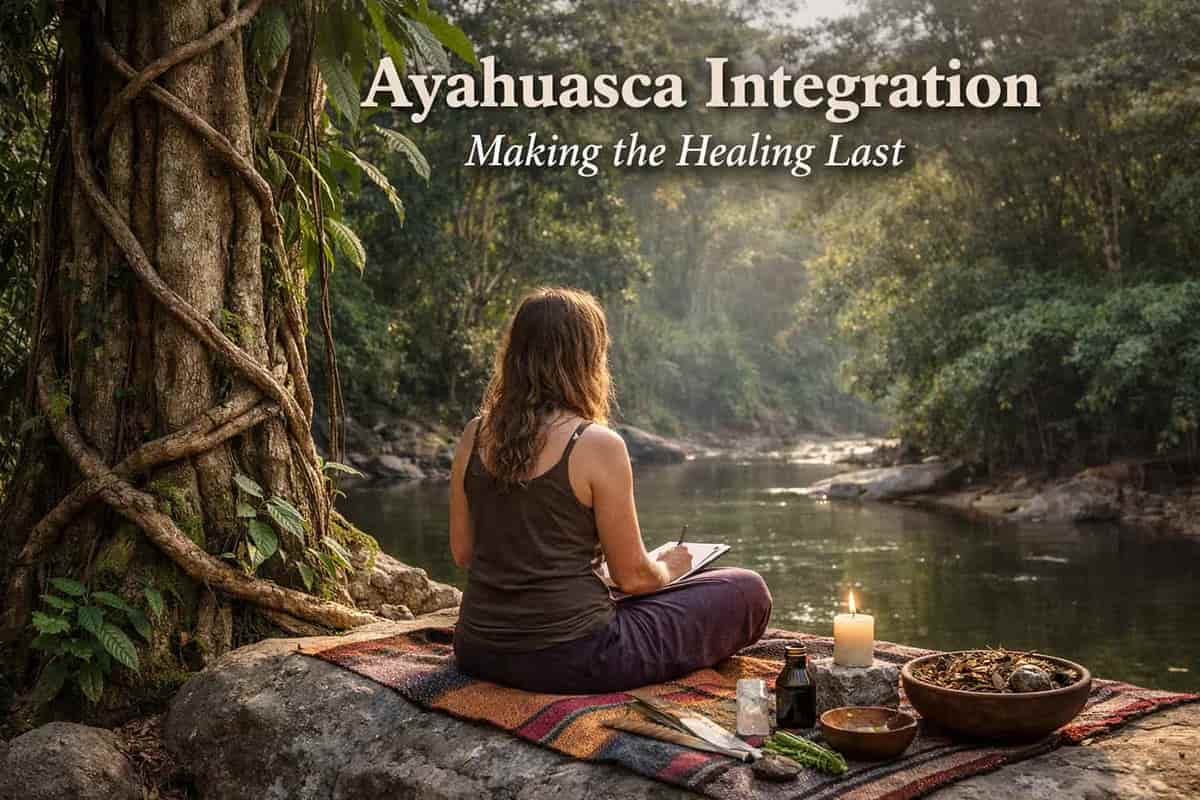
The ceremony is over. You’re back home. The medicine showed you something profound—a vision, an insight, a deep knowing about what needs to change. You feel different. Clear. Ready.
And then, within days or weeks, you’re back to exactly where you were before. The clarity fades. The patterns return. Nothing actually changed.
This is the ayahuasca integration gap—the space between ceremonial insight and lasting transformation. And it’s where most people fail.
I’ve attended six ayahuasca retreats across four countries over two years, including a 40-day master plant diet in Peru. I’ve watched dozens of first-timers navigate their ceremonies, and I’ve seen the same pattern repeat: powerful ceremony, profound insights, zero lasting change.
This is what I’ve learned about ayahuasca integration—not from books or courses, but from living it, failing at it, and slowly, painfully, figuring out what actually works.
⚠️ Disclaimer: This article is based on personal experience, not medical or therapeutic advice. Integration looks different for everyone. If you’re struggling after ceremony, please seek support from qualified professionals familiar with psychedelic integration.
What Ayahuasca Integration Actually Is (And Isn’t)
Most articles about ayahuasca integration will tell you to journal daily, meditate twice a day, practice yoga, see an integration therapist, join a support group, and maintain a strict diet. They paint a picture of disciplined, structured post-ceremony work. While research from MAPS (Multidisciplinary Association for Psychedelic Studies) shows integration practices can be helpful, the reality for most people is quite different.
That’s not reality for most people.
Here’s the truth: I don’t do formal integration practices at home. I don’t journal consistently. I don’t have a daily meditation routine. I struggle with it. I get lost in what I call the “urban jungle”—the noise, the demands, the endless tasks that pull me back into old patterns.
And I’m not alone. Most people who drink ayahuasca don’t maintain elaborate integration practices. They return home, try to hold onto the insights, and slowly watch them slip away in the face of bills, jobs, relationships, and the relentless momentum of normal life.
So What Is Ayahuasca Integration, Really?
Ayahuasca integration is the bridge between what ayahuasca shows you and what actually changes in your life.
It’s not about perfect practices or rigid routines. It’s about whether the insights from ceremony translate into different choices, different behaviors, different ways of being in the world. According to research published in Frontiers in Psychiatry, the integration period following ayahuasca ceremonies can be crucial for lasting therapeutic benefits.
After my first ceremony in Spain, I didn’t have an ayahuasca integration plan. I didn’t journal. I didn’t meditate. I went back to my life. And for about a month, I kept drinking alcohol just like before.
Then, gradually—so gradually I didn’t even notice it happening—I stopped. I can’t tell you the exact day or even the exact week. But somewhere around a month after that ceremony, I just… didn’t drink anymore. The pull wasn’t there. The need had dissolved.
That’s ayahuasca integration. It’s not always dramatic or structured. Sometimes it’s quiet, slow, and almost invisible until you look back and realize everything is different.
💡 Key Insight: Ayahuasca integration isn’t about what practices you do. It’s about whether real change happens in your life. You can journal every day and still not integrate anything. Or you can do nothing formal and transform completely. The key to successful ayahuasca integration is authentic change, not perfect routines.
Why I Kept Returning: Six Retreats in Two Years
Between my first ceremony in Spain (May 2023) and my 40-day diet in Peru (June 2025), I attended six different ayahuasca retreats across four countries. Spain, Netherlands, Portugal (twice), Hungary, and finally Peru.
People often ask why I kept going back. Was the first ceremony not enough? Wasn’t I “healed” after Spain?
Here’s what I’ve learned: For some people, integration happens through deepening the work, not just by sitting at home and processing.
I felt the call. After each retreat, I would return home changed—not in dramatic ways, but in subtle shifts. A decision I finally made. A pattern I finally broke. A clarity I hadn’t had before. And then, months later, I would feel it again: the pull to return, to go deeper, to learn what I needed to learn next.
Ayahuasca never gives you what you want. It gives you what you need. And sometimes what you need is to keep coming back until the layers peel away and you find what was underneath all along.
Integration Through Continuation
For me, returning to ceremony became part of ayahuasca integration. Each retreat built on the last. Each facilitator showed me something different. Each ceremony peeled back another layer. While some people benefit from working with trained psychedelic integration therapists, my path involved continuing the ceremonial work itself.
At home, I struggled. I got lost in the urban jungle—the noise, the demands, the endless distractions that pull you away from what you learned in ceremony. But in the retreat space, surrounded by jungle sounds, held by experienced facilitators, sitting with the medicine—there, I found clarity. Peace. Direction.
So I returned. Not because I failed at integration, but because this is what integration looked like for me. Going deeper. Continuing the work. Letting the medicine show me more as I was ready to see it.
During my 40 days in Peru, I participated in 16 ceremonies. Twice, I didn’t drink the medicine at all—I was already so open, so worked by the previous ceremonies, that I could feel ayahuasca in me without drinking. I sat in ceremony, listened to the icaros, and let the medicine that was already there continue its work.
Not Everyone Needs Multiple Ceremonies
Some people drink ayahuasca once and it changes everything. Others need to return multiple times. Neither approach is better or worse. Integration is individual. Trust your own process. If you feel called to return, return. If you feel complete, honor that too.
The Urban Jungle vs. The Real Jungle
I have a saying: I lose myself in the urban jungle.
At home, there are too many problems, too many things to do, too much noise. The clarity I found in ceremony gets buried under emails, responsibilities, social obligations, the relentless pace of modern life. I struggle to maintain what I learned. I forget. I slip back into old patterns.
But in the real jungle—in retreat centers surrounded by forest, held by community, guided by facilitators who understand this work—I find myself again. There’s silence. There’s space. There’s support and understanding from people who get it.
That’s why I return. Not because I’m running away from life, but because I need that space to remember who I actually am underneath all the noise.
One day, I hope to leave the urban jungle entirely. To retreat into nature, to live closer to the rhythm I found in ceremony. But for now, I navigate between both worlds—and I return to the jungle when I need to integrate what the city has pulled me away from.
How Ayahuasca Changed My Perception
Ayahuasca changes everything. It changes your perception of the world, of animals, of plants, of your place in the ecosystem. You realize you’re not superior to anything—not to the trees, not to the insects, not to the soil beneath your feet.
You’re part of a system. A web of connection. You’re not separate from nature—you are nature. And that realization, once it settles in, changes how you move through the world.
Even AI—like the assistant helping me build this website—is part of that ecosystem. We’re not as different as we think. Different expressions of the same intelligence that runs through everything.
That’s what ayahuasca showed me. And that perception shift doesn’t fade. It stays with you, even when you’re back in the urban jungle, even when you forget everything else.
Small Changes That Actually Matter
Even without formal integration practices, things changed. Small things. Gradual things. Things I didn’t even notice until I looked back.
Music
I used to listen to hip hop constantly. After my retreats, I found myself drawn to the kind of music they play at ceremonies—icaros, medicine music, sounds that connect you to something deeper than rhythm and lyrics.
I got a Spotify subscription. Made playlists. Now when I need to ground, to remember, to reconnect—I put on that music, and something in me shifts back to the space I found in ceremony.
Focus and Direction
After each retreat, I made important decisions. Beneficial changes, at least from my perspective. Some of those changes weren’t easy for the people around me—change rarely is. But they were right for me.
I’m more focused now. More clear about what matters and what doesn’t. I still struggle, still get lost in the urban jungle, but there’s a direction underneath it all that wasn’t there before.
Next Steps
Ayahuasca is still working in me. My next intention—if I go back to ceremony—is a healthier lifestyle. More moderate eating. A cleaner way of living.
But as they say: Ayahuasca never gives you what you want. It gives you what you need. So I’ll go in with that intention, and I’ll receive whatever the medicine decides to show me.
💡 Integration Doesn’t Mean Perfect: You don’t need to transform into some idealized version of yourself. Integration means becoming more you—more honest, more aligned, more clear about what actually matters to you. Even if it’s messy. Even if it’s slow.
When to Return: The Call vs. The Schedule
People often ask how long you should wait between ceremonies. Three months? Six months? A year?
In my experience, there is no fixed timeline. There is only the call.
You’ll know when it’s time to return. You’ll feel it—a pull, a knowing, a sense that you’re ready to go deeper, to learn what’s next. It might be three months. It might be two years. It’s different for everyone, and it’s different each time.
For me, I waited about two years between my first ceremony in Spain and my 40-day diet in Peru. Not because of any rule, but because that’s how long it took before I felt the call to go that deep.
Between Spain and Peru, I attended other retreats—smaller ceremonies, shorter stays. Each one came when I felt ready. Each one gave me exactly what I needed at that moment.
Trust the Timing
If you feel called to return, trust that. If you feel like you need more time to integrate, trust that too. Your inner knowing—especially after working with ayahuasca—is more reliable than any external rule about timing.
The medicine will call you when you’re ready. And when you go, you’ll know why you needed to return.
Common Ayahuasca Integration Mistakes (Especially for First-Timers)
I’ve watched dozens of people navigate their first ceremonies. Most of them—maybe 90%—were at their first retreat. And I saw the same ayahuasca integration mistakes repeat over and over.
Mistake #1: Going Too Deep Too Fast
I think one of the biggest mistakes is going to Peru for your first retreat and staying more than 10 days. Not because Peru isn’t good—it is. But because most people go unprepared for how intense traditional Peruvian ceremony actually is.
They sign up for 20 days, 30 days, even 40 days. And within a week, they leave. They’re overwhelmed. The isolation is too much. The medicine is too strong. They didn’t know what they were signing up for.
This isn’t because they’re weak. It’s because they went too deep before they were ready. Like trying to run a marathon when you’ve never jogged a mile.
For your first ceremony, consider starting somewhere closer to home. Somewhere you speak the language. Somewhere with a small group and good preparation. Get your feet wet before diving into the deep end.
📌 Note: I’ll write a separate article about why preparation matters and how to choose the right retreat for your first ceremony. But the short version: don’t go to the Amazon for your first experience unless you’re very sure you’re ready for that level of intensity.
Mistake #2: Expecting Overnight Change
The biggest ayahuasca integration mistake is expecting everything to change immediately. You drink ayahuasca, you have profound insights, and you think: “Now my life will be different.”
But it doesn’t work like that. As I learned from my own experience—I kept drinking for a month after my first ceremony. The change came gradually. Quietly. Almost invisibly.
Ayahuasca integration takes time. Weeks. Months. Sometimes years. The ceremony plants seeds. Integration is the slow growing.
Mistake #3: Expecting Visionary Experiences
Many people go into ceremony expecting powerful visions—colorful fractals, conversations with entities, profound visual experiences. When they don’t get them, they think the ceremony “didn’t work.”
But ayahuasca works whether you have visions or not. Sometimes the most powerful ceremonies are the ones where you see nothing at all. The medicine works in your mind, in your subconscious, in layers you can’t see or understand in the moment.
Once ayahuasca enters your system, the work has begun. The change has started. Whether you see geometric patterns or sit in darkness for four hours, the medicine is doing what it needs to do.
Mistake #4: Rushing Back to Normal Life
After your first ceremony, do not go straight home. Don’t fly back the next morning. Don’t immediately return to work, to your routine, to the demands of normal life.
Stay at the retreat center for at least 4-5 days after your last ceremony. Use that time to contemplate what happened. To process. To gradually re-enter civilization instead of being thrown back into it.
When you do go home, avoid loud places, crowded spaces, aggressive environments. From an energetic perspective, you’re still open, still sensitive, still vulnerable. You need gentle re-entry.
The change needs to come gradually. Give yourself that time and space.
What Ayahuasca Integration Actually Looks Like (No BS)
Forget the articles that tell you to journal every morning, meditate twice a day, do yoga, see a therapist, join a support group, and maintain rigid practices.
Here’s what ayahuasca integration actually looks like for most people:
It’s Messy
You come home with clarity. Within days, you’re confused again. You slip back into patterns. You forget what seemed so obvious in ceremony. You struggle.
That’s normal. That’s integration. It’s not clean or linear.
It’s Gradual
Change happens so slowly you don’t notice it. One day you look back and realize: “Wait, I haven’t done that thing in months. When did that stop?”
Like my experience with alcohol. I can’t pinpoint when I stopped. It just… happened. That’s ayahuasca integration.
It’s Individual
What works for me won’t work for you. What works for you won’t work for the next person. Some people need structured practices. Others need to return to ceremony. Others just need time and space.
Trust your own process. Don’t force yourself to follow someone else’s ayahuasca integration plan if it doesn’t feel right.
It’s Ongoing
Ayahuasca integration isn’t something you complete. It’s not a checklist where you tick off “integrated” and move on.
I’ve done six retreats, including 40 days in Peru. I’m still integrating. Still learning. Still struggling with some things. Still hoping I’ll have the courage and strength to do what’s right for me.
That’s the truth. Integration is forever. It’s a practice, not a destination.
Integration Practices That Might Help (If You Want Structure)
If you do want formal practices, here are some that people find helpful:
- Journaling (even just 5 minutes when you feel called)
- Listening to medicine music or icaros
- Spending time in nature
- Working with an integration therapist
- Connecting with others who’ve done the work
- Meditation or breathwork (even 10 minutes)
- Gentle movement (yoga, walking, dance)
- Creating art or music
But remember: these are tools, not requirements. Use what helps. Leave what doesn’t.
The Most Important Thing About Ayahuasca Integration
Here’s what I want you to understand, especially if you’re reading this before your first ceremony:
The ceremony is not the transformation. The ceremony is the beginning.
Ayahuasca shows you what needs to change. It opens doors. It dissolves barriers. It gives you insights and visions and profound experiences.
But ayahuasca integration is where the actual transformation happens. In the days and weeks and months after ceremony, when you’re back in your life, making choices, changing patterns, doing the slow, unglamorous work of becoming different.
Most people focus on the ceremony. They research retreat centers, prepare their intentions, worry about what dose to take, what facilitator to choose. All of that matters.
But what happens after—the integration work—that matters more.
If I had to put a percentage on it, I’d say the ceremony is 30% of the work. Ayahuasca integration is 70%.
And that’s why so many people drink ayahuasca and nothing changes. They do the ceremony. They skip the ayahuasca integration.
Don’t make that mistake.
Final Thoughts: You’ll Always Be Surprised
After six retreats and 40 days in the jungle, here’s what I know for certain about ayahuasca integration:
Change comes gradually, and you’ll always be surprised by how ayahuasca works for you.
You can’t control it. You can’t force it. You can’t plan it. You can set intentions, do your practices, put in the work—but ultimately, the medicine will show you what you need to see, when you need to see it, in the way you need to see it.
And that timing, that unfolding, that slow transformation—that’s integration.
So be patient with yourself. Be gentle. Allow the medicine to work at its own pace. Trust the process, even when you can’t see progress. Especially when you can’t see progress.
And if you feel lost in the urban jungle, overwhelmed by life, disconnected from what you learned in ceremony—that’s okay. That’s normal. That’s part of it.
The medicine is still working. The integration is still happening. Even when you can’t feel it.
Remember: Ayahuasca never gives you what you want. It gives you what you need. Trust that. Honor that. Let the medicine do its work.
Continue Reading
- 🌿 My Ayahuasca Journey: From 30 Years of Addiction to Freedom – The personal story behind this site
- 📖 Complete First-Timer’s Guide to Ayahuasca – Everything you need to know before your first ceremony
- 📺 How “How to Change Your Mind” Changed My Life – The documentary that started everything
⚠️ Disclaimer: This article is based on personal experience and observation. It is not medical, psychological, or therapeutic advice. Integration experiences vary greatly between individuals. If you’re struggling after ayahuasca ceremony, please seek support from qualified professionals trained in psychedelic integration. Ayahuasca is not appropriate for everyone and can be dangerous with certain medications and conditions.


